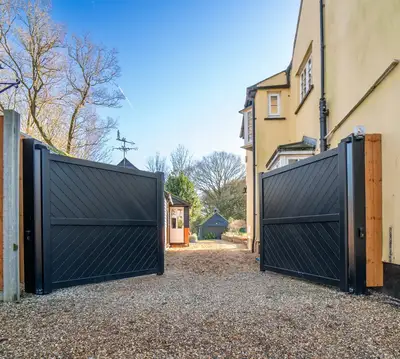
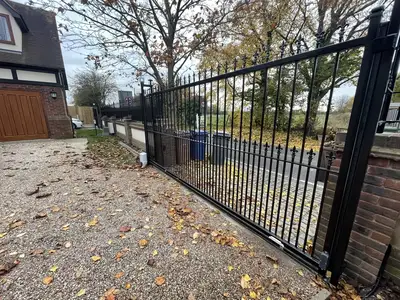
Automated driveway gates in swing, sliding, telescopic, cantilever and radial configurations. We help you choose the right system for your driveway, then handle every aspect of installation.
Not every gate system suits every driveway. The shape of your entrance, the gradient of your drive, the space available for the gate to move, and how often vehicles will pass through all play a role in determining the best configuration.
We start every project with a free on-site survey to assess these factors and recommend the most suitable system. Below is an overview of the five main configurations we install, along with when each one works best.
Book a free site survey
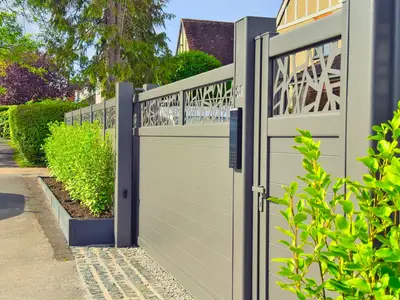
Each configuration has distinct advantages. The right choice depends on your driveway layout, terrain and usage.
The classic choice. Swing gates open inward or outward on hinges, offering an elegant entrance. They require clearance space equal to the gate width and reduce usable driveway length when open. Best for wider driveways with ample depth.
Sliding gates move horizontally along a ground track, preserving the full length of your driveway. They require space to one side (approximately 600mm plus the gate width) for the gate to slide into. Ideal for shorter driveways or busy entrances.
A telescopic system uses overlapping panels that stack behind each other, reducing the required sliding space by roughly half compared to a standard slider. More complex to install, but sometimes the only viable option for compact properties.
Cantilever gates run on a support wheel structure above ground, staying level without touching the surface. Perfect for sloping driveways, loose gravel or heavy vehicle traffic where a ground track would be impractical or prone to damage.
The most specialised configuration. Radial gates use a curved track for a unique swing-and-slide motion. Rarely used due to their complexity and safety considerations, but they offer an elegant solution where other systems cannot fit.
Unlike many gate companies, we handle every element of the project in-house. Our team carries out all groundworks, brickwork, electrical connections, automation, intercom integration and CCTV — so your entire project is managed by a single contractor with a single point of contact.
This means no subcontractor delays, no miscommunication between trades, and a consistent standard of workmanship from the foundations to the final handover. Our bespoke sub-ground structural support system, developed with our manufacturing partners, allows us to install foundations and restore your driveway in hours rather than days.
Call 01375 886299
Every gate system above is available in a choice of materials. Explore each range to find the right fit for your property and budget.
Rust-proof, lightweight and maintenance-free with warranties up to 30 years. Our most popular choice for residential driveways.
Explore aluminium gates
The warmth of wood from 95% recycled materials. A great option for homeowners who want a natural look at a competitive price.
Explore composite gates
Maximum strength for ornamental residential and high-security commercial applications. Galvanised and powder coated for durability.
Explore steel gatesAnswers to the questions we hear most about driveway gate systems, installation and planning.
For short driveways, a sliding or telescopic gate is usually best. Swing gates reduce usable driveway length when open, which can be a problem if there is limited space between the gate and the road. Sliding gates move horizontally and preserve the full depth of your driveway.
Yes. Cantilever gates are specifically designed for sloping, uneven or loose gravel surfaces. They run on a support wheel structure above ground level rather than a track, so they stay level regardless of the terrain beneath them.
If the driveway is already prepared, swing gates typically take 2–3 days and sliding gates 1–2 days for beam and wiring. Bespoke manufacture takes 2–4 weeks for steel or composite and 6–10 weeks for aluminium. Our sub-ground structural system can be installed within 7 days of order, allowing driveway works to continue while the gate is manufactured.
In most cases, no — provided the gate is no taller than 2 metres (or 1 metre if adjacent to a highway). If your property is listed or in a conservation area, you may need additional permissions. We advise checking with your local authority before proceeding, and we are happy to help with this.
Get in touch for a free site survey and no-obligation quote.